Profile A: Inputs 12 and 18
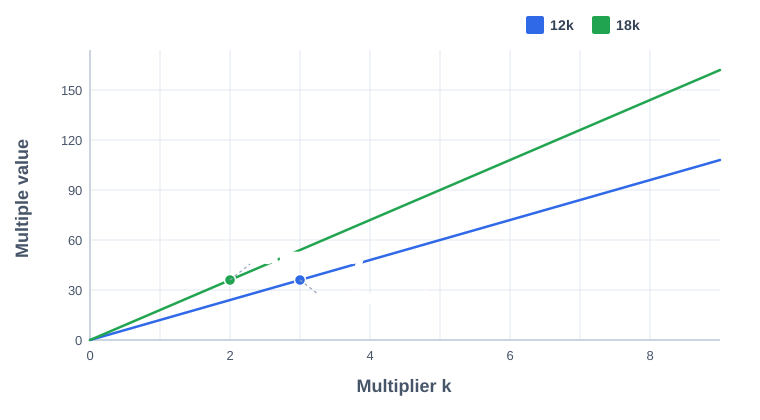
The shared target is $36$. For $12$, that occurs at $k=3$. For $18$, it occurs at $k=2$. This profile is the clean baseline for LCM via GCD logic.
This LCM calculator finds the least common multiple of two or three integers and shows the complete method step by step. Enter $a$ and $b$ (with optional $c$) to compute the final LCM, inspect the GCD stage used internally, and verify edge cases such as negatives and zero values using explicit conventions. For related number-structure methods, explore Number Theory.
Enter two integers (and optional c) to compute the least common multiple with step-by-step method output.
Integer values only. Decimals are not allowed.
You can use negative numbers too.
Optional third value
Your feedback matters
The least common multiple (LCM) is the smallest non-negative integer divisible by every input value. This tool is built for educational number-theory workflows where you need the result and the derivation. It is useful for fraction denominator alignment, periodic event synchronization, and integer planning tasks where exact divisibility matters more than approximation.
The calculator accepts two required integers plus one optional third integer. It computes the answer with a GCD-based method and surfaces each intermediate step so users can audit the arithmetic instead of trusting opaque output. This makes it suitable for classroom review, assignment checking, and method learning.
For two non-zero integers: $\operatorname{lcm}(a,b)=\frac{|ab|}{\gcd(a,b)}$. For three integers, the tool applies chaining: $\operatorname{lcm}(a,b,c)=\operatorname{lcm}(\operatorname{lcm}(a,b),c)$. This policy keeps the implementation deterministic and easy to validate at each pair stage.
Internally, each GCD is computed by the Euclidean algorithm. Compared with manual listing of multiples, Euclid scales better and avoids noisy search over long sequences. The step output therefore reflects a mathematically standard and computationally efficient path.
This calculator is for integer input. Negative integers are accepted and normalized by absolute value during LCM computation, so sign does not alter the final non-negative LCM. Decimal input is outside standard integer LCM scope and should be normalized first.
Use the summary for quick interpretation, the computed table for canonical values, and the step-by-step block for method traceability. A reliable post-check is simple: every input must divide the reported LCM with remainder zero. For two-number stages, validate identity consistency: $\operatorname{lcm}(a,b)\cdot\gcd(a,b)=|ab|$.
For denominator workflows, treat LCM as a construction target rather than a simplification endpoint. For periodic workflows, treat it as the first shared synchronization point. This interpretation prevents common mistakes where users mix reduction goals (GCD) and alignment goals (LCM).
In search terms, this page directly covers LCM of 3 numbers, the least common denominator use case, and the core LCM and GCD relationship used for fast integer computation.
The live chart reflects your exact inputs. The static profiles below provide two educational anchors: a baseline two-input case and a chained three-input case. Both visuals use the same style and show how each input reaches the shared LCM at its own multiplier step.
The shared target is $36$. For $12$, that occurs at $k=3$. For $18$, it occurs at $k=2$. This profile is the clean baseline for LCM via GCD logic.
The shared target is $180$. Multipliers to reach that target are $k=15$ for 12, $k=10$ for 18, and $k=6$ for 30. This makes chained LCM behavior easy to inspect visually.
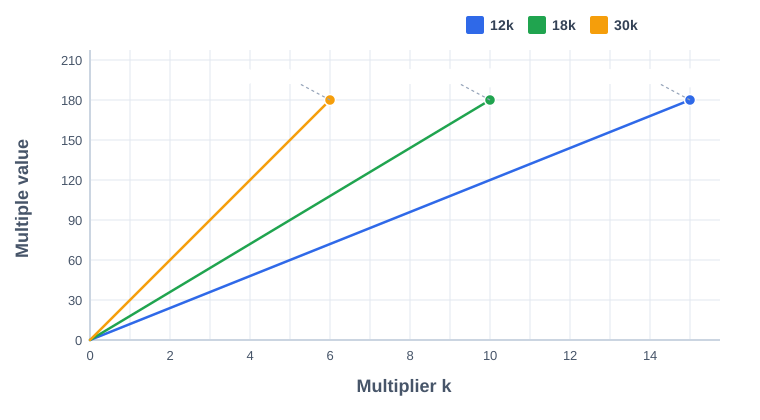
Comparison takeaway: LCM is a discrete alignment concept. Inputs do not need the same multiplier value to meet. They only need to reach the same multiple target.
Find: $$\operatorname{lcm}(12,18)$$
Compute: $$\gcd(12,18)=6,\quad \operatorname{lcm}(12,18)=\frac{|12\cdot18|}{6}=36$$
Add: $$\frac{1}{6}+\frac{1}{8}+\frac{5}{12}$$ Denominator target: $$\operatorname{lcm}(6,8,12)=24$$
Convert: $$\frac{1}{6}=\frac{4}{24},\ \frac{1}{8}=\frac{3}{24},\ \frac{5}{12}=\frac{10}{24}$$ $$\frac{4}{24}+\frac{3}{24}+\frac{10}{24}=\frac{17}{24}$$
Find: $$\operatorname{lcm}(12,18,30)=\operatorname{lcm}(\operatorname{lcm}(12,18),30)$$
First stage: $$\gcd(12,18)=6,\quad \operatorname{lcm}(12,18)=36$$
Second stage: $$\gcd(36,30)=6,\quad \operatorname{lcm}(36,30)=180$$ $$\operatorname{lcm}(12,18,30)=180$$
$$\operatorname{lcm}(0,15)=0,\quad \operatorname{lcm}(0,0)=0\ (\text{site convention})$$
This calculator keeps the all-zero case deterministic to avoid undefined-response ambiguity in tool workflows.
LCM is commonly computed by three routes: listing multiples, prime-factor exponents, and GCD-based reduction. Listing is intuitive but inefficient at scale. Prime-factor form is educationally rich but can be verbose for hand work. GCD reduction is usually the most practical calculator method and is the method used here.
Frequent errors include mixing decimal inputs into an integer model, forgetting absolute-value normalization for negatives, and confusing LCM goals (alignment) with GCD goals (reduction). A good validation sequence is: check divisibility by each input, verify non-negative output, and confirm pair identity with GCD.
Students often ask whether they should use multiple listing, prime factorization, or the GCD formula first. The answer depends on objective and scale. For very small classroom values, listing multiples helps build intuition. For structural understanding, prime factors reveal exponent maxima clearly. For repeat execution and larger integers, the GCD formula is usually the most robust route. A practical study pattern is to compute with GCD, then explain with prime factors. That pairing preserves speed and conceptual clarity at the same time.
LCM also appears in applied contexts beyond fractions. In cycle alignment tasks, it gives the first simultaneous event time. In deterministic simulations, it can define the smallest repeat window for periodic states. In programming classes, it is used for loop synchronization and integer-normalization exercises. In each case, the core interpretation remains stable: LCM is the first compatible shared scale across integer systems. This page intentionally keeps that interpretation explicit so users can transfer the method across domains.
From a teaching perspective, it helps to separate three competencies: procedural fluency, structural understanding, and validation discipline. Procedural fluency means a learner can compute GCD and LCM correctly. Structural understanding means they can explain why factor structure controls the result. Validation discipline means they test divisibility and identity checks before accepting output. Tools that support all three competencies usually produce stronger retention and fewer arithmetic regressions than pages that only present final answers.
Convention transparency is equally important. Some academic references treat the all-zero case differently; this calculator explicitly returns zero by tool convention so pipelines remain deterministic. If your local coursework uses another policy, document that policy and apply it consistently across notes, homework, and test checks. Consistent convention application is more important than convention style, because inconsistent policy handling is a common source of avoidable grading errors.
In number-theory instruction, LCM is often introduced as a procedural arithmetic skill and then revisited later as a structural concept. That sequence is useful, but many learners keep the early procedural view and miss the structural interpretation. A stronger academic progression is to connect methods explicitly: show listing for intuition, show factorization for structure, and show GCD-based derivation for computational efficiency. When all three are presented as equivalent routes to the same value, students build mathematical flexibility rather than memorizing a single mechanical pattern.
If you are designing assignments, separate prompts by cognitive objective. Ask one question that tests execution speed, one that tests explanation quality, and one that tests convention handling. For example: compute LCM quickly from two values; explain why the same value follows from factor exponents; and describe how your chosen convention handles a zero case. This mixed format reveals whether the learner can transfer method knowledge across contexts or only replicate a memorized pattern. It also produces cleaner feedback loops because error origin becomes visible: arithmetic slip, conceptual gap, or policy mismatch.
For self-study, use a short repeatable checklist after each computation. First, verify divisibility of the reported LCM by every input. Second, confirm that no smaller positive candidate satisfies all divisibility checks in simple cases where quick inspection is feasible. Third, if using a two-number stage, verify the product identity with GCD. Fourth, record edge-case interpretation explicitly so your notes remain consistent when reviewed later. This checklist takes less than a minute for most examples and dramatically reduces silent error accumulation across practice sets.
Finally, treat LCM as part of a broader mathematical workflow rather than an isolated endpoint. In fraction arithmetic, it prepares denominator alignment. In ratio and proportion contexts, it supports scale harmonization. In modular and periodic reasoning, it defines first synchronization windows. In coding exercises, it helps coordinate integer-step loops. Seeing LCM as infrastructure for later operations improves retention because learners understand why the value matters after it is computed. That is also why this page keeps method, examples, chart intuition, and validation in one continuous sequence.
For deeper mastery, compare near-neighbor input sets and observe how the LCM reacts to factor overlap. For instance, compare pairs like $12,18$ and $12,20$: both look similar in size, but shared factor structure changes the result materially. Then compare triples where one value is already a multiple of another, and notice that not every added input increases the LCM. This kind of contrastive practice helps learners move beyond size intuition and toward divisor-structure reasoning. It also improves exam performance because many assessment questions are designed to test whether students can distinguish between “larger inputs” and “stronger overlap.” A page that teaches this distinction explicitly is usually more useful than one that only shows isolated computations.
A final practical tip for instructors and self-learners is to log one sentence after each solved problem: “why this LCM value is minimal.” Writing that sentence forces the minimality idea into working memory and reduces a common error where learners verify divisibility but forget to test whether a smaller common multiple exists. That reflection step is short, but over repeated practice it sharply improves conceptual precision.
Use GCD Calculator when your task is reduction, simplification, or shared-factor extraction. Use Prime Factorization Calculator when you want prime-exponent structure behind LCM decisions.
Rosen, Kenneth H. Elementary Number Theory and Its Applications, 6th ed., Pearson. This text is a standard academic reference for divisibility, GCD, and LCM foundations used in this calculator.
Keep exploring Number Theory, expand to Mathematics, or browse all Calculators.