This escape velocity calculator computes minimum escape speed from mass and radius using $v_e=\sqrt{2GM/r}$.
In this model, Earth surface escape velocity is about $11.2\ \mathrm{km/s}$.
For closely related orbital and transfer planning context, continue in
Space Calculators.
Compute escape velocity from mass and radius.
Results
Summary
Escape velocity (m/s):—
Escape velocity (km/s):—
Escape velocity (% of c):—
Surface gravity at radius (m/s^2):—
Specific escape energy (J/kg):—
Required escape velocity vs altitude
Step-by-step
Explanation:
Computed values
Metric
Value
Your feedback matters
What This Escape Velocity Calculator Solves
This tool solves the classical two-body escape threshold from a spherical mass.
It answers a simple question: what is the minimum speed to escape gravity from a given radius?
If the body has mass $M$ and launch distance is $r$, the threshold is
$$v_e=\sqrt{\frac{2GM}{r}}$$
Use it to check surface escape velocity, compare bodies, and verify custom mass-radius cases.
The complete read includes formula derivation, worked calculation steps, and interpretation guidance.
If you want the full Earth workflow step by step, see Example 1 below.
The output is intentionally more than one number. Alongside escape speed in m/s and km/s, the tool reports
speed as a percent of $c$.
It also reports local gravitational acceleration at the same radius and specific escape energy.
That bundle gives better physical context for mission discussions, educational interpretation, and quick comparisons
across planets, moons, and custom bodies. You can use it for clean baseline checks before moving to full trajectory modeling.
Formula, Inputs, and Physical Meaning
The model is Newtonian and uses:
$$v_e=\sqrt{\frac{2GM}{r}}$$
This is the standard Newtonian escape velocity relation for spherical two-body assumptions.
Here, $G$ is the gravitational constant, $M$ is body mass, and $r$ is center distance.
For surface escape velocity, set $r$ equal to body radius.
For altitude-dependent cases, use $r=R+h$.
This is the core escape velocity formula derivation path used in the calculator.
Escape speed falls with altitude because the required potential climb decreases as $r$ increases.
Equivalent forms help interpretation:
$$g=\frac{GM}{r^2},\qquad v_e=\sqrt{2gr},\qquad \epsilon_{esc}=\frac{v_e^2}{2}=\frac{GM}{r}$$
Here $\epsilon_{esc}$ is specific escape energy in J/kg. This quantity is useful because it compares gravity-well depth directly,
independent of vehicle mass. Scaling is immediate: for fixed radius, $v_e\propto\sqrt{M}$; for fixed mass, $v_e\propto1/\sqrt{r}$.
These relations are often more useful than memorizing isolated planetary values.
How to Use the Result Correctly
Interpret this output as an ideal threshold, not a full mission delta-v budget. Real launches lose performance to atmospheric drag,
gravity losses during finite-thrust ascent, steering, staging constraints, and engine efficiency limits.
So if the calculator says 11.19 km/s for Earth, that does not mean a launch vehicle only needs 11.19 km/s total mission delta-v.
It means the gravity-well threshold from a purely idealized energy viewpoint is 11.19 km/s.
The practical value is comparability. If Body A has much higher $v_e$ than Body B, it has a deeper gravity well and generally harder direct escape.
In other words, higher $v_e$ means higher gravitational escape speed at the same reference distance.
The local $g$ and specific escape energy fields reinforce this interpretation.
The percent-of-$c$ value is included for scale awareness.
For planets and moons, it is usually tiny, so Newtonian treatment is generally sufficient.
When to Use Related Space Tools
Escape velocity answers "can it escape in principle?"
It does not answer orbit period or transfer delta-v between circular orbits.
For timing and orbit-duration questions, use Orbital Period Calculator.
For transfer design context between two orbital radii, use Hohmann Transfer Calculator.
These tools are complementary: escape speed frames gravity-well depth, orbital period frames time, and Hohmann transfer frames maneuver cost.
If your next question is about gravitational boundaries in multi-body systems, use the same workflow pattern.
Start from threshold speed, then add orbit timing, transfer mechanics, and domain limits.
Practical Decision Workflow
If you are using this for real planning logic, a practical sequence is:
first compute escape velocity at the departure radius.
Next test whether propulsion can reach that speed after losses.
Then compare against transfer strategy requirements.
Finally estimate destination-side constraints.
This keeps the tool in its proper role as a fast baseline, not a mission optimizer.
A frequent user mistake is mixing "can escape" with "can reach destination efficiently."
Escaping a gravity well is only one part of mission cost. Trajectory geometry, transfer windows, capture requirements,
and operational margins can dominate total budget depending on mission type.
In other words, a feasible escape threshold does not automatically imply a feasible end-to-end mission profile.
Pairing escape speed with orbital-period and transfer tools gives a much more realistic planning baseline.
For quick analysis, this workflow prevents shallow interpretation.
For engineering use, it works as early triage in concept studies.
High specific escape energy usually means tougher propulsion requirements and tighter mass margins.
How to Read the Escape Profile Chart
The line chart plots required escape speed (km/s) against altitude above the reference radius.
It is not a launch trajectory path; it is a static threshold profile showing how the required local escape speed decays with radial distance.
The marker at 0 km corresponds to your input radius result. As altitude increases, the curve slopes downward because gravitational potential barrier decreases.
The shape is nonlinear and follows inverse-square-field behavior through the square-root relation.
What the chart is best for:
Quick comparison of how escape threshold changes with altitude.
Pre-design intuition about gravity-well behavior.
What it is not for:
Real ascent losses, staging points, or finite-burn mission profiles.
If a reader treats this as a flight profile, they will overestimate practical gains from altitude.
If they treat it as a threshold map, it is highly useful.
In mission language, this chart gives you a clean local energy barrier view.
That is especially useful when explaining differences between small-body operations, lunar operations, and deep-gravity launch environments.
The same chart concept also helps when discussing high-altitude starts, orbital departure assumptions, and why transfer planning must still follow.
Comparative Escape-Speed Profiles
The live chart above reflects your exact inputs.
These static profiles give two anchors for comparison.
Earth is a moderate-deep launch environment.
Moon is a shallow one.
Axes in the static SVGs are unit-only (`km` and `km/s`) so the same visuals can be reused across all locales.
The goal is interpretation consistency, not replacing your custom-input chart.
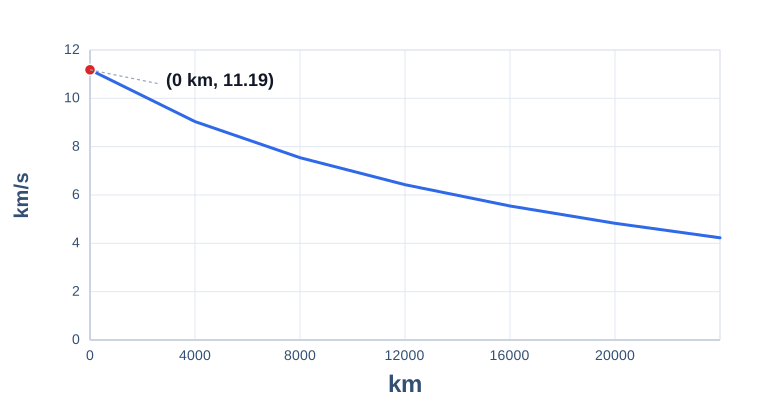
Profile A: Earth Baseline
Using Earth-like mass and radius, surface escape velocity is about $11.19\ \mathrm{km/s}$.
The curve then declines with altitude because required local escape speed drops as center distance increases.
In this profile, the blue curve is the Earth trend and the red marker is the surface point $(0\ \mathrm{km},\,11.19\ \mathrm{km/s})$.
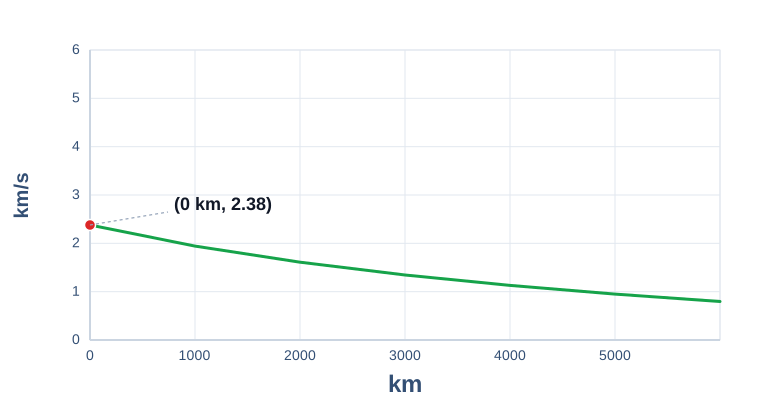
Profile B: Moon Baseline
With Moon-like parameters, surface escape velocity is about $2.38\ \mathrm{km/s}$.
The lower baseline highlights how much shallower lunar escape is compared with terrestrial launch conditions.
In this profile, the green curve is the Moon trend and the red marker is the surface point $(0\ \mathrm{km},\,2.38\ \mathrm{km/s})$.
Comparison takeaway: deeper gravity wells demand substantially higher local escape speed at the same reference altitude frame.
This is why Earth launch architecture and lunar departure architecture differ so strongly in propulsion pressure.
Cross-check from local gravity:
$$g=\frac{GM}{r^2}\approx9.82\ \mathrm{m/s^2},\qquad v_e=\sqrt{2gr}\approx11185.98\ \mathrm{m/s}$$
Specific escape energy:
$$\epsilon_{esc}=\frac{v_e^2}{2}\approx6.26\times10^7\ \mathrm{J/kg}=62.6\ \mathrm{MJ/kg}$$
This confirms a deep gravity well and a high ideal threshold compared with smaller bodies.
Example 2: Moon Surface Escape Velocity
Given:
$$M=7.342\times10^{22}\ \mathrm{kg},\quad r=1.7374\times10^6\ \mathrm{m}$$
Formula and substitution:
$$v_e=\sqrt{\frac{2GM}{r}}=\sqrt{\frac{2(6.67430\times10^{-11})(7.342\times10^{22})}{1.7374\times10^6}}$$
Compute:
$$v_e\approx2375.9\ \mathrm{m/s}=2.376\ \mathrm{km/s}$$
This is far below Earth's value, which is why lunar ascent and return architectures require much less ideal escape speed.
The local gravity cross-check is also consistent: using lunar $g$ and $r$ reproduces the same order of magnitude.
Example 3: Mars Surface Escape Velocity
Given:
$$M=6.4171\times10^{23}\ \mathrm{kg},\quad r=3.3895\times10^6\ \mathrm{m}$$
Formula and substitution:
$$v_e=\sqrt{\frac{2GM}{r}}=\sqrt{\frac{2(6.67430\times10^{-11})(6.4171\times10^{23})}{3.3895\times10^6}}$$
Compute:
$$v_e\approx5027\ \mathrm{m/s}=5.027\ \mathrm{km/s}$$
Interpretation: Mars sits between Moon and Earth in gravity-well depth, and the number aligns with common mission design expectations.
This is a good cross-check case for anyone validating custom-body calculations.
Example 4: Altitude Effect (Same Body)
Keep Earth mass fixed and compare two radii.
Surface case:
$$r_1=6.371\times10^6\ \mathrm{m}\Rightarrow v_{e1}\approx11.186\ \mathrm{km/s}$$
Higher-altitude case with doubled radius:
$$r_2=2r_1\Rightarrow v_{e2}=v_{e1}\sqrt{\frac{r_1}{r_2}}=\frac{v_{e1}}{\sqrt{2}}\approx7.91\ \mathrm{km/s}$$
This is the same trend shown in the chart: larger radius means lower local escape threshold.
The decay is nonlinear, not a straight-line drop.
Example 5: Mass-Radius Tradeoff Check
Start from:
$$v_e=\sqrt{\frac{2GM}{r}}$$
Equal radius, mass ratio $M_2/M_1=4$:
$$\frac{v_{e2}}{v_{e1}}=\sqrt{\frac{M_2}{M_1}}=\sqrt{4}=2$$
Equal mass, radius ratio $r_2/r_1=4$:
$$\frac{v_{e2}}{v_{e1}}=\sqrt{\frac{r_1}{r_2}}=\sqrt{\frac{1}{4}}=\frac{1}{2}$$
This scaling check matches the calculator's model logic exactly and is useful for sanity-checking custom inputs before mission-level analysis.
Common Mistakes That Distort Results
Unit mismatch: entering radius in km while the formula expects meters.
Confusing escape velocity with circular orbital velocity at the same radius.
Interpreting ideal threshold as actual launch vehicle delta-v requirement.
Using body diameter where radius is required.
Comparing results across sources with inconsistent constants and rounding policy.
Fast validation routine:
Verify SI units: kg for mass and m for radius.
Compute $v_e$ in m/s first, then convert to km/s.
Cross-check with known Earth, Moon, and Mars ranges.
Review specific escape energy to confirm trend direction.
This routine catches most practical errors quickly.
Scope, Reliability, and Next Navigation
The method is reliable for Newtonian planetary-scale baselines and educational/engineering pre-checks.
It is not a substitute for full trajectory optimization, ascent simulation, or mission-specific constraints.
It is not a differential-equation trajectory solver.
Use it as a first-pass decision layer.
If threshold speed and specific energy are high, downstream mission complexity is usually high.
You can also estimate escape velocity of the Sun by entering solar mass and radius.
For escape velocity of a black hole, use relativistic framing near the event horizon.
Continue in Space Calculators for orbital, launch, and transfer tools.
Then move up to Physics Calculators for broader mechanics and energy topics.
For the top-level index, use All Calculators.