Profile A: Unique Root
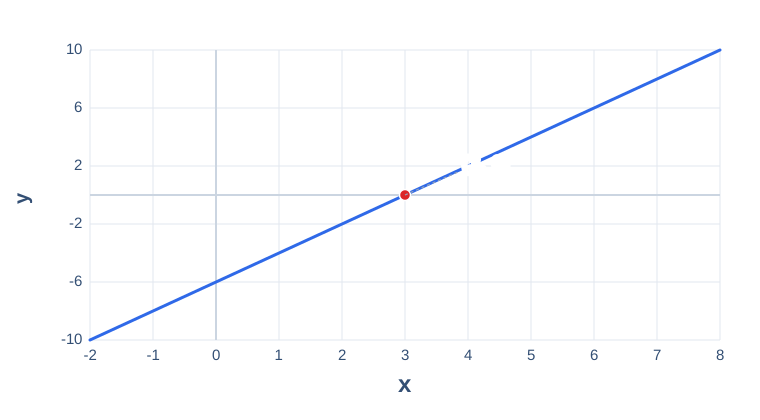
For $2x - 6 = 0$, the line $y=2x-6$ crosses the x-axis at $x=3$, so the equation has one solution.
This linear equation solver computes equations in the form $ax + b = 0$ with clear steps, instant classification, and graph output. Enter $a$ and $b$ to get the solution for $x$ when it exists, plus a direct explanation for no-solution and infinite-solution cases. If you want more equation tools in the same workflow, start from Algebra.
Enter coefficients a and b to solve ax + b = 0.
Coefficient of x.
Constant term.
Your feedback matters
This page solves first-degree equations in one variable: $ax + b = 0$. It is designed for people who need a fast answer and a transparent method at the same time. Common use cases include solving for $x$, checking why an equation has no solution, and confirming when every real number satisfies the equation.
The tool does more than return a number. It classifies the equation type, shows the algebraic transition line by line, and visualizes the line $y=ax+b$ so you can confirm where (or whether) it crosses the x-axis. That makes it practical for both verification and interpretation.
For $a \ne 0$, isolate $x$: $ax+b=0 \Rightarrow ax=-b \Rightarrow x=-\frac{b}{a}$. This yields exactly one solution. The special branch is when $a=0$, where the equation becomes constant: no solution if $b \ne 0$, and infinitely many solutions if $b=0$.
In other words, the solver follows a strict three-way split: unique solution, contradiction, or identity. This classification is the core of reliable one-variable equation solving and prevents common interpretation errors.
Use this sequence every time: (1) move the constant term to the other side, (2) divide by the coefficient of $x$, (3) check whether dividing is valid ($a \ne 0$). The calculator exposes each of these steps in output so the process stays auditable.
For decimal and negative coefficients, the method does not change. Only arithmetic precision changes. A quick validation routine is to substitute the computed $x$ back into $ax+b$ and confirm the result is 0 (or very close due to rounding display).
The chart renders $y=ax+b$. A unique solution appears where the line intersects the x-axis. No-solution and infinite-solution branches are also visible from the graph logic: horizontal nonzero level for contradiction, and full-axis overlap condition for identity form. This is useful when users search "linear equation graph and root" or "x-intercept from ax + b."
If your target is multiple variables instead of one-variable form, use 2x2 System of Equations Solver. Keep this page for single-variable linear structure only.
The solver accepts integers and decimals for both coefficients. Edge handling is explicit, and output type always states whether the result is unique, none, or infinite. Use this checklist to avoid incorrect conclusions:
If the equation includes $x^2$, move to Quadratic Equation Solver for second-degree solving logic.
These static charts complement the live chart above with three core patterns: a unique root, a no-solution branch, and an identity case. Together they make the result classification easy to read before you inspect numeric output.
For $2x - 6 = 0$, the line $y=2x-6$ crosses the x-axis at $x=3$, so the equation has one solution.
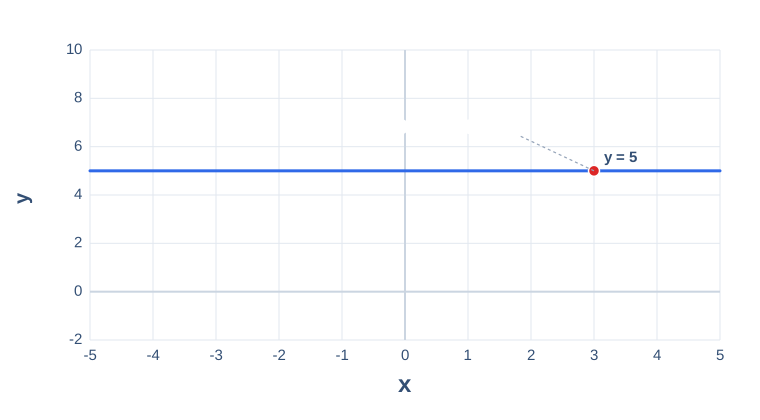
For $0x + 5 = 0$, the graph is the horizontal line $y=5$, which never touches the x-axis. This corresponds to a contradiction and no solution.
For $0x + 0 = 0$, the graph is $y=0$, exactly on the x-axis. The statement is true for every real $x$, so solutions are infinite.
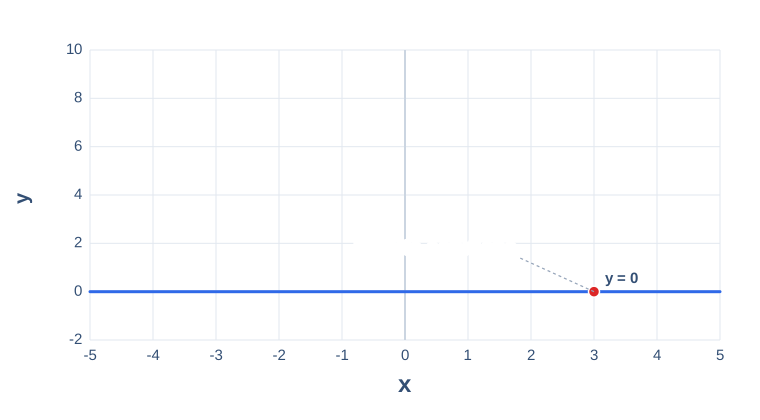
Quick takeaway: one intersection gives one root, no intersection gives no solution, and full overlap with the x-axis means infinitely many solutions.
Solve: $$3x - 12 = 0$$
$$3x = 12$$ $$x = \frac{12}{3} = 4$$
Solve: $$0.5x + 1.25 = 0$$
$$0.5x = -1.25$$ $$x = \frac{-1.25}{0.5} = -2.5$$
Solve: $$0x + 7 = 0$$
This becomes: $$7 = 0$$ Contradiction, so there is no solution.
$$0x + 0 = 0 \Rightarrow 0 = 0$$ Identity, so every real number satisfies the equation.
Every transformation in this solver preserves equation equivalence: subtracting or adding the same value on both sides, then dividing by $a$ only when $a \ne 0$. This is why $ax+b=0$ and $x=-\frac{b}{a}$ represent the same solution set in the unique-solution branch. For quality control, always substitute the returned value into $ax+b$ and verify that it evaluates to 0.
This tool is limited to one-variable first-degree equations. If $a=0$, the solver classifies the result without division: contradiction when $b \ne 0$, identity when $b=0$. If the expression includes powers higher than 1, use a dedicated non-linear solver.
The method and classifications on this page align with standard algebra references used in secondary and introductory college mathematics.
Continue in Algebra, broaden to Mathematics, or browse all Calculators on UtilityKits.