Profile A: Unique Solution
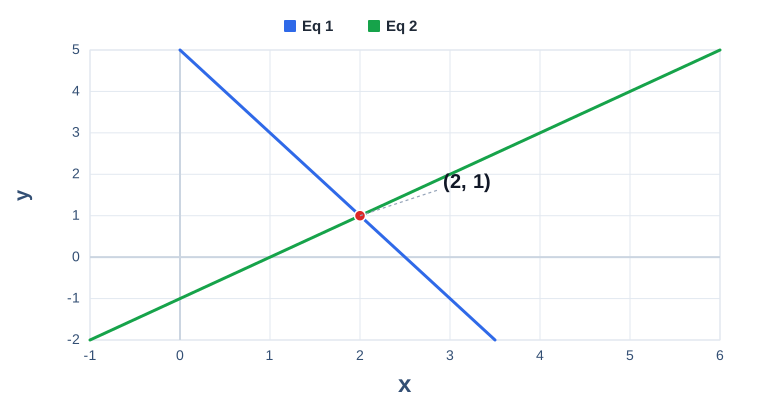
For $2x+y=5$ and $x-y=1$, lines intersect at one point. This corresponds to $D\ne0$ and a single $(x,y)$ solution.
This 2x2 system of equations solver solves two linear equations in two variables with full determinant steps and graph interpretation. Enter coefficients for $a_1x+b_1y=c_1$ and $a_2x+b_2y=c_2$ to get $D$, $D_x$, $D_y$, solution type, and intersection insight. For closely related methods, start from Algebra.
Solve a 2x2 system in the form:
Your feedback matters
This tool solves systems in the form $a_1x+b_1y=c_1$ and $a_2x+b_2y=c_2$. It covers the most common needs for a 2x2 equation solver: solving for $x,y$, checking whether a system is consistent, and validating two-variable results. Output is not just numeric; it classifies whether the system is unique, inconsistent, or dependent.
Geometrically, each equation is a line in the xy-plane. A single intersection gives one solution, parallel lines give no solution, and overlapping lines give infinitely many solutions. The calculator connects determinant algebra with this line-intersection behavior so interpretation stays consistent.
The method uses three determinants: $D=a_1b_2-a_2b_1$, $D_x=c_1b_2-c_2b_1$, $D_y=a_1c_2-a_2c_1$. When $D\ne0$, the unique solution is $x=\frac{D_x}{D}$ and $y=\frac{D_y}{D}$.
Determinant logic also gives immediate classification: $D=0$ with $D_x=D_y=0$ means infinitely many solutions, while $D=0$ with at least one of $D_x,D_y$ nonzero means no solution. This is the core of reliable 2x2 system classification.
Use this sequence: (1) map coefficients into determinant form, (2) compute $D$, $D_x$, $D_y$, (3) classify by determinant conditions, (4) compute $x,y$ only when $D\ne0$. This keeps branch logic explicit and prevents mixing formulas across cases.
The same workflow works for integers, decimals, and negative coefficients. A quick validation path is substitution: plug solved $x,y$ into both original equations and confirm both equalities hold. This catches arithmetic slips in determinant expansion or sign handling.
Determinants are not only algebraic shortcuts; they encode line behavior. The value of $D=a_1b_2-a_2b_1$ reflects whether the line directions are distinct. If $D\ne0$, direction vectors are not proportional, so lines must intersect exactly once. If $D=0$, directions are proportional, so lines are either parallel (no intersection) or fully overlapping (same line). This is why determinant classification and graph classification always agree when coefficients are interpreted consistently.
The pair $(D_x,D_y)$ then determines whether a single point can satisfy both equations when $D=0$. Nonzero $D_x$ or $D_y$ signals incompatibility between constants and coefficient ratios, producing an inconsistent system. Zero values for both indicate compatibility with infinitely many points on the same line. This branch logic prevents invalid operations such as dividing by zero and keeps the solver mathematically grounded.
The chart plots both lines from your exact coefficients. If they intersect once, the intersection point is the unique solution. If they are parallel, the system is inconsistent. If they overlap, the equations describe the same line and the solution set is infinite.
For three equations and three variables, continue with System of Equations Solver (3x3).
Use this page when you have exactly two linear equations with two unknowns. If your task is one-variable linear form, use Linear Equation Solver. If the model is nonlinear, switch to a solver built for that structure before interpreting any result.
For 2x2 systems specifically, Cramer's rule is strongest when you need explicit branch visibility: compute $D$, decide type, then compute $x,y$ only in the unique branch. Elimination is often faster by hand for sparse coefficients, while matrix inverse form is useful in linear algebra workflows where matrix operations are already in use. In this tool, determinant-first output is intentional because it provides both solution values and branch justification in one trace.
These static profiles highlight the two clearest visual outcomes for 2x2 systems: one intersection and no intersection. They connect determinant classification to visible line behavior without compressing the chart cards.
For $2x+y=5$ and $x-y=1$, lines intersect at one point. This corresponds to $D\ne0$ and a single $(x,y)$ solution.
For $x+y=2$ and $2x+2y=5$, lines are parallel and never meet, so the system is inconsistent. Determinant pattern is $D=0$ with nonzero $D_x$ or $D_y$.
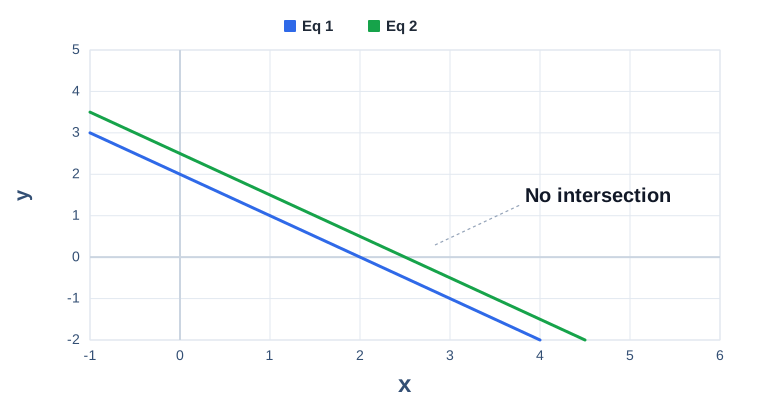
Summary: one crossing means one solution, while parallel lines mean no solution.
Solve: $$\begin{cases} 2x + y = 5\\ x - y = 1 \end{cases}$$
$$D=(2)(-1)-(1)(1)=-3$$ $$D_x=(5)(-1)-(1)(1)=-6$$ $$D_y=(2)(1)-(1)(5)=-3$$
$$x=\frac{D_x}{D}=2,\quad y=\frac{D_y}{D}=1$$
Solve: $$\begin{cases} x + y = 2\\ 2x + 2y = 5 \end{cases}$$
$$D=(1)(2)-(2)(1)=0$$ $$D_x=(2)(2)-(5)(1)=-1$$ $$D_y=(1)(5)-(2)(2)=1$$
Since $D=0$ but $D_x,D_y$ are not both zero, the system has no solution.
Solve: $$\begin{cases} x + 2y = 4\\ 2x + 4y = 8 \end{cases}$$
$$D=0,\quad D_x=0,\quad D_y=0$$
All three determinants are zero, so the two equations represent the same line and the system has infinitely many solutions.
Solve: $$\begin{cases} 0.5x + 1.5y = 2\\ 1.25x - 0.5y = 0.75 \end{cases}$$
$$D=(0.5)(-0.5)-(1.25)(1.5)=-2.125$$ $$D_x=(2)(-0.5)-(0.75)(1.5)=-2.125$$ $$D_y=(0.5)(0.75)-(1.25)(2)=-2.125$$
$$x=\frac{D_x}{D}=1,\quad y=\frac{D_y}{D}=1$$ Substitution check: both equations evaluate correctly at $(1,1)$.
Cramer's rule is an exact determinant-based method for square linear systems. For 2x2 systems, it provides both classification and explicit solution formulas under the condition $D\ne0$. The method is algebraically consistent with line-intersection geometry, so symbolic and visual interpretations agree.
This page assumes two linear equations in two variables. Decimal and negative coefficients are valid. Very small determinant values can be numerically sensitive, so branch classification should be read alongside displayed precision.
Near-singular systems deserve extra care. When $D$ is extremely close to zero, small input changes can produce large swings in computed $x,y$. In practical terms, this means the system is almost parallel and numerically fragile. For these cases, determinant classification remains useful, but numeric interpretation should include tolerance awareness and direct substitution checks.
Most incorrect outputs come from determinant sign errors or column substitution mistakes. Use this checklist before trusting a final answer.
Fast validation routine: verify determinant branch, then substitute solved values into both equations. If both left sides equal their constants, the solution is consistent.
Use this four-step audit whenever output quality matters:
This workflow is intentionally redundant: determinant logic validates classification, substitution validates arithmetic, and graph behavior validates interpretation. Using all three together minimizes false confidence from a single mistaken step.
This page is maintained as method documentation for live solver output. Formulas and branch criteria follow standard linear algebra treatment for 2x2 systems.
Continue in Algebra, expand to Mathematics, or browse all Calculators on UtilityKits.