Profile A: Two Real Intersections
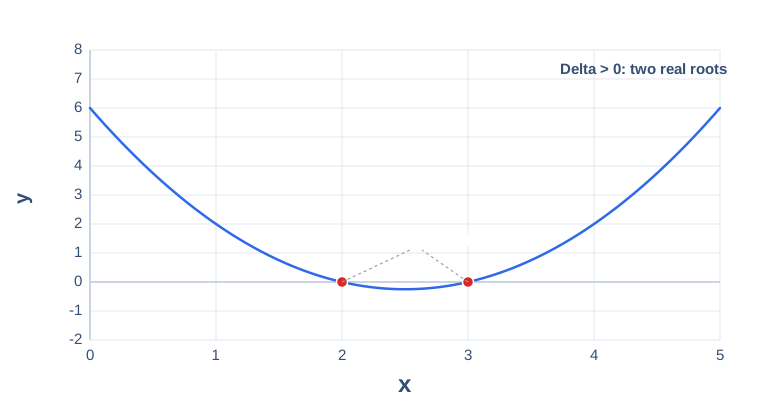
For $x^2-5x+6=0$, the curve crosses the x-axis at two points ($x=2$, $x=3$), which matches $\Delta>0$.
Step-by-step solutions, method comparison, and live parabola visualization in one workflow.
This solver evaluates each input with quadratic formula, factoring, and vertex-form logic together, then shows which method is most appropriate for the case. You get clear outputs for real, repeated, complex, and linear-reduction cases, plus a live graph so you can see how coefficient changes shift the curve and roots. For equation-focused workflows beyond quadratics, explore related algebra calculators.
Quick links: Method Comparison | Comparative Quadratic Profiles | Quadratic Formula Examples | Common Mistakes
Solve equations in the form:
Quick links: Live Chart | Quadratic Formula | Factoring | Vertex Form
If a = 0, the equation becomes linear (bx + c = 0).
Your feedback matters
A quadratic equation has degree two and is written as $ax^2 + bx + c = 0$ with $a \ne 0$. The practical objective is to find values of $x$ that satisfy the equation exactly. This page is designed for practical solving use where you need both final roots and method confidence, not just a single numeric output line.
The solver returns two real roots, one repeated real root, or a complex conjugate pair depending on the discriminant. It also handles the boundary case $a=0$ as a non-quadratic path so the output remains mathematically explicit. This makes the tool useful for quick checks, decision support, and reliable validation in applied math workflows.
The quadratic formula is: $$x = \frac{-b \pm \sqrt{b^2 - 4ac}}{2a}$$ where $a$, $b$, and $c$ are coefficients from standard form. The expression under the square root, $\Delta = b^2 - 4ac$, determines root type before final simplification.
This discriminant-first interpretation is critical in real use: it tells you what kind of answer to expect before finishing arithmetic, and it prevents sign and branch errors when evaluating $\pm$.
Use a strict four-stage sequence. First, map the equation into $ax^2 + bx + c = 0$ and confirm coefficient signs. Second, compute the discriminant exactly. Third, substitute into the quadratic formula and simplify each branch. Fourth, verify by substitution in the original equation where needed. This is the most reliable workflow for step-by-step solving tasks.
Common errors are almost always procedural: copying $b$ without sign, dropping the denominator $2a$, or applying the square root incorrectly when $\Delta < 0$. The step output in this tool is designed to expose these checkpoints so mistakes are visible early.
This solver assumes real-valued coefficients and standard-form input. Coefficients may be integers or decimals. If $a=0$ and $b\ne 0$, the equation is linear, not quadratic. If $a=0$ and $b=0$, the equation is degenerate and does not define a standard solvable quadratic model.
Factoring is fast when coefficients are simple and integer patterns are obvious. The quadratic formula is universal and stable across all coefficient types. Completing the square is best when you need structural interpretation (vertex form, shifts, and geometry) in addition to roots. If your objective is transformation and graph meaning rather than direct root extraction, continue with Completing the Square Calculator.
Practical decision rule: choose factoring for quick pattern hits, choose formula for guaranteed root output, and choose completing-the-square when structural interpretation is the priority. Keeping this method discipline improves both speed and accuracy under practical time constraints.
The result block separates equation classification, discriminant value, and root expressions. Use this order when interpreting output: first root type, then numeric values, then validation by substitution. If the live chart is shown for your inputs, use it as a behavior check: two x-axis intersections indicate two real roots, tangency indicates a repeated root, and no intersection indicates complex-only roots. This pairing of algebra output plus curve behavior reduces interpretation mistakes.
For review or reporting, keep coefficient values and discriminant in your final write-up. Those two items make your method auditable even when final roots are rounded. In advanced settings, this also helps reconcile solver output with symbolic algebra systems.
In repeated quadratic work, result quality depends more on setup discipline than on formula memorization. Start by rearranging the equation into standard form $ax^2 + bx + c = 0$, then read coefficients directly with signs preserved. This normalization step prevents the most common input mistakes and keeps discriminant interpretation reliable.
For decimal or fractional coefficients, keep full precision until the final line and round only for display. In formal write-ups, state the discriminant and root class before writing final numeric roots. In applied workflows, include the discriminant value in reports because it explains whether the model has two real intersections, one repeated contact point, or no real intersection.
The live chart reflects your exact inputs. These static profiles provide two benchmark views: one with two real roots and one with complex roots. Both keep identical visual tokens so the discriminant-to-graph relationship is easy to compare.
For $x^2-5x+6=0$, the curve crosses the x-axis at two points ($x=2$, $x=3$), which matches $\Delta>0$.
For $x^2+2x+5=0$, the curve does not intersect the x-axis and has vertex $(-1,4)$, which aligns with $\Delta<0$ and complex conjugate roots.
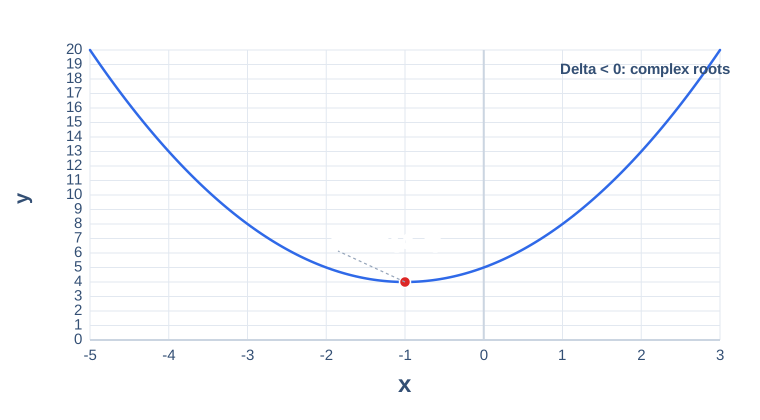
Comparison takeaway: discriminant sign predicts graph behavior directly. Positive gives two intersections, zero gives tangency, and negative gives no real intersection.
Solve: $$x^2 - 5x + 6 = 0$$ Coefficients: $a=1,\; b=-5,\; c=6$.
Discriminant: $$\Delta = (-5)^2 - 4(1)(6)=25-24=1>0$$ So there are two distinct real roots.
Formula application: $$x=\frac{-(-5)\pm\sqrt{1}}{2(1)}=\frac{5\pm1}{2}$$ $$x_1=3,\quad x_2=2$$
Solve: $$x^2 - 4x + 4 = 0$$ Coefficients: $a=1,\; b=-4,\; c=4$.
Discriminant: $$\Delta = (-4)^2 - 4(1)(4)=16-16=0$$ So there is one repeated real root.
Formula application: $$x=\frac{-(-4)\pm\sqrt{0}}{2}=\frac{4\pm0}{2}=2$$
Solve: $$x^2 + 2x + 5 = 0$$ Coefficients: $a=1,\; b=2,\; c=5$.
Discriminant: $$\Delta = 2^2 - 4(1)(5)=4-20=-16<0$$ So roots are complex.
Formula application: $$x=\frac{-2\pm\sqrt{-16}}{2}=\frac{-2\pm4i}{2}=-1\pm2i$$
Consider: $$0x^2 - 5x + 3 = 0$$ This is linear because $a=0$.
Solve as linear: $$-5x+3=0\Rightarrow x=\frac{3}{5}=0.6$$ Use this as a validation checkpoint for the boundary case where $a=0$.
In real solving workflows, consistency matters more than speed. A defensible result should classify root type, preserve coefficient signs, and confirm at least one solution path against the original equation.
Use this compact sequence:
This flow is fast, repeatable, and resistant to common sign and branch errors.
A 30-second quality check is enough for most cases: confirm discriminant sign, confirm denominator, and substitute one computed root back into the original expression. For complex cases, also check conjugate symmetry in the two solutions.
Continue with Algebra tools.
Quick answers about formula use, discriminant meaning, and root types.