Profile A: Moderate Regime
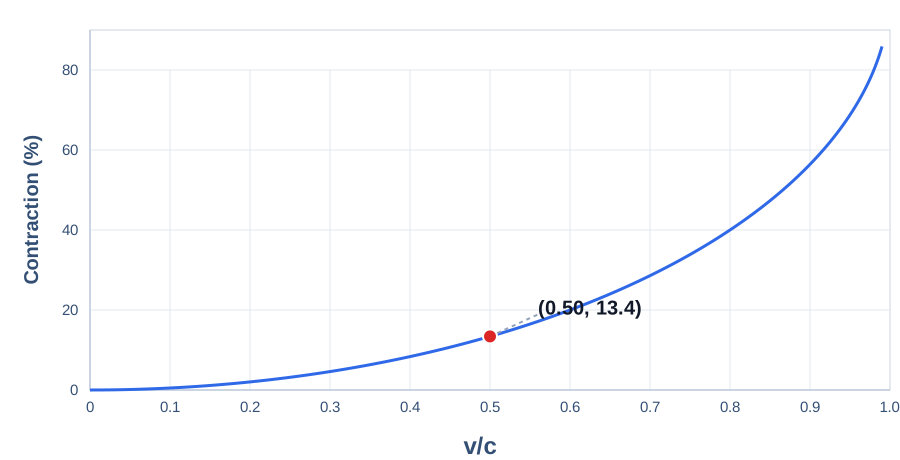
At $v/c=0.50$, contraction is about $13.4\%$. This is a practical baseline for understanding how to calculate length contraction step by step without extreme edge effects.
This length contraction calculator computes observed moving-frame length from rest length and velocity using special relativity. Enter rest length and speed to apply the Lorentz contraction formula step by step, then interpret both contracted length and total contraction. For related high-speed frame analysis, explore Relativity.
Compute contracted length from rest length and velocity.
Your feedback matters
This tool solves special-relativity length contraction for one-dimensional motion along the measurement axis. Given proper length $L_0$ and relative speed $v$, it computes Lorentz factor $\gamma$, observed contracted length $L$, and contraction amount $\Delta L = L_0 - L$. It is designed for users who need a reliable length contraction formula workflow with explicit variable meaning, consistent SI units, and clear interpretation of frame-dependent output.
In practical use, this supports common intents such as "how to calculate length contraction," "proper length vs observed length," and "Lorentz contraction calculator with steps." The goal is not only to produce a number, but to show how that number follows from a valid high-speed model.
The calculator uses $\gamma = \frac{1}{\sqrt{1-(v/c)^2}}$ and $L = \frac{L_0}{\gamma}$, where $c$ is the speed of light in vacuum. Here, $L_0$ is proper length (measured in the object's rest frame), and $L$ is the length measured in a frame where the object moves at speed $v$. The ratio $v/c$ is dimensionless and must satisfy $0 \le v < c$.
The contraction effect occurs only along the direction of relative motion. Transverse dimensions are unchanged in this model. This directional condition is essential: applying contraction to unrelated axes is a common interpretation error.
Proper length is not "more real" than observed length. Both are physically valid measurements attached to different inertial frames. The calculator reports both the resulting observed length and the absolute difference from the rest-frame length, so you can quantify not only final scale but also how much geometric contraction appears at that speed.
This distinction is critical in engineering-style reasoning and educational work: if you mix frame definitions, you can get mathematically consistent arithmetic with physically inconsistent conclusions. Keeping frame labels explicit is the safest way to avoid this failure mode.
The live chart inside the calculator is best for your exact inputs. This static comparison adds two reference profiles so you can quickly see how contraction behavior changes between moderate relativistic speed and near-light-speed conditions. Both visuals use the same axis scale and the same underlying contraction model, so shape differences reflect physics rather than formatting.
At $v/c=0.50$, contraction is about $13.4\%$. This is a practical baseline for understanding how to calculate length contraction step by step without extreme edge effects.
At $v/c=0.90$, contraction rises to about $56.4\%$. This illustrates why small speed-ratio changes near $c$ can produce large geometric differences in observed length.
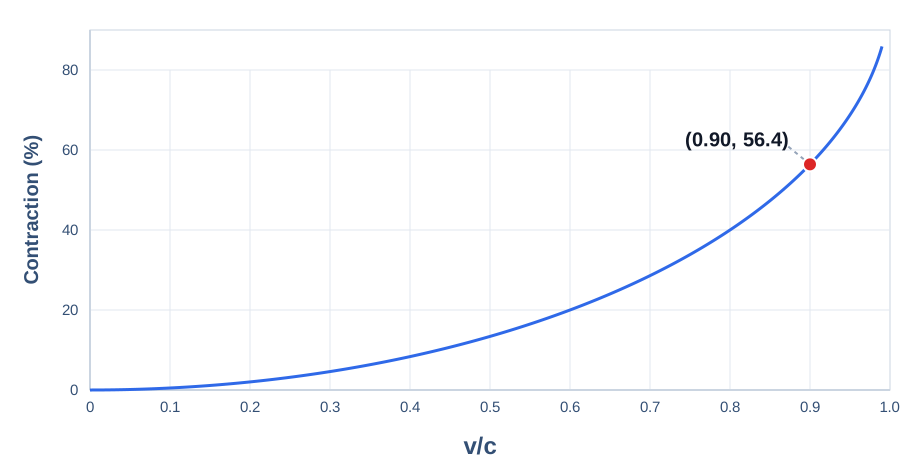
Comparison takeaway: contraction remains relatively gentle at moderate values of $v/c$, then accelerates in a clearly nonlinear way as velocity approaches light speed. This is why high-speed frame interpretation should always be done with explicit frame labels.
This baseline checks the full workflow from velocity ratio to gamma to contracted length.
Given: $$L_0 = 1\,\mathrm{m},\quad \frac{v}{c}=0.5$$ $$\gamma = \frac{1}{\sqrt{1-0.5^2}} = \frac{1}{\sqrt{0.75}} \approx 1.154701$$
$$L = \frac{L_0}{\gamma} = \frac{1}{1.154701} \approx 0.866025\,\mathrm{m}$$ $$\Delta L = L_0 - L = 1 - 0.866025 = 0.133975\,\mathrm{m}$$
Interpretation: at half light speed, contraction is moderate and clearly measurable.
Use this to see nonlinear growth of relativistic effects at near-light speed.
Given: $$L_0 = 2\,\mathrm{m},\quad \frac{v}{c}=0.9$$ $$\gamma = \frac{1}{\sqrt{1-0.9^2}} = \frac{1}{\sqrt{0.19}} \approx 2.294157$$
$$L = \frac{2}{2.294157} \approx 0.871780\,\mathrm{m}$$ $$\Delta L = 2 - 0.871780 = 1.128220\,\mathrm{m}$$
Interpretation: most of the rest length is contracted in the observed frame at this velocity range.
This scenario is useful for infrastructure-scale thought experiments or high-speed craft geometry checks.
Given: $$L_0 = 100\,\mathrm{m},\quad \frac{v}{c}=0.8$$ $$\gamma = \frac{1}{\sqrt{1-0.8^2}} = \frac{1}{0.6} = 1.666667$$
$$L = \frac{100}{1.666667} \approx 60\,\mathrm{m}$$ $$\Delta L = 100 - 60 = 40\,\mathrm{m}$$
Interpretation: contraction can become large in absolute meters for long objects even at sub-extreme values of $v/c$.
This calculator is a special-relativity inertial-frame model. It does not include acceleration phases, curved-spacetime effects, or gravitational contributions. Inputs must satisfy $0 \le v < c$, with rest length strictly positive. For trustworthy output, validate units first, then verify that trend behavior is physically sensible as $v/c$ increases.
A strong validation habit is to back-check with the inverse relation: if $L = L_0/\gamma$, then $L_0 = \gamma L$ should recover the original rest length within rounding tolerance. This catches both unit slips and accidental frame swaps quickly.
Length contraction is a standard consequence of Lorentz transformations in special relativity. For historical foundation, consult Einstein's 1905 paper on electrodynamics of moving bodies. For constants and SI anchor values, use NIST references for the speed of light and unit definitions. For concept-level summaries of Lorentz-FitzGerald contraction, high-quality encyclopedic references are also useful.
Suggested references: Einstein (1905), On the Electrodynamics of Moving Bodies, NIST, Meter Definition and Speed of Light Context, Britannica, Lorentz-FitzGerald Contraction.
If your next question is about clock divergence rather than geometric contraction, continue with the Time Dilation Calculator. If you need high-speed momentum and energy state comparisons, use Relativistic Energy Calculator.
Keeping geometry and timing questions separated at first usually improves clarity, then you can combine both outputs in a single frame-consistent interpretation when needed.
Continue with Relativity, expand to Physics Calculators, or browse all Calculators.