This relativistic momentum calculator computes momentum at high velocity using
$p=\gamma m v$ and compares it with the classical estimate $p=mv$.
Use it to calculate momentum near light speed, inspect the Lorentz factor, and quantify where classical mechanics starts underestimating results.
For companion tools in the same framework, continue with
Relativity.
Compute relativistic momentum and compare with classical momentum.
Results
Summary
Rest mass (kg):—
Velocity (m/s):—
v/c:—
Speed as % of c:—
Lorentz factor (gamma):—
Relativistic momentum (kg*m/s):—
Classical momentum (kg*m/s):—
Relativistic / classical ratio:—
Relativistic and classical momentum (kg*m/s) vs velocity ratio
Step-by-step
Explanation:
Computed values
Metric
Value
Your feedback matters
What This Relativistic Momentum Solver Is For
This tool is built for high-speed momentum calculations where velocity is a meaningful fraction of the speed of light.
It is designed for users who need to calculate relativistic momentum step by step, apply the
$p=\gamma m v$ formula correctly, and compare relativistic momentum vs classical momentum in the same workflow.
Instead of returning one opaque number, it shows velocity ratio $v/c$, Lorentz factor $\gamma$,
relativistic momentum, classical momentum, and their ratio so model behavior is immediately interpretable.
Formula, Variables, and Model Interpretation
The calculator applies special relativity in inertial-frame conditions:
$\gamma = \frac{1}{\sqrt{1-(v/c)^2}}$,
$p_{rel}=\gamma m v$, and
$p_{classical}=mv$.
Here $m$ is rest mass in kilograms and $v$ is velocity in m/s.
The momentum ratio
$\frac{p_{rel}}{p_{classical}}=\gamma$
provides a direct measure of relativistic correction.
As $v/c$ rises, $\gamma$ increases nonlinearly, so relativistic momentum diverges from classical predictions.
Practically, this means low-speed scenarios often show near-classical agreement, while near-light-speed scenarios can produce large underestimation if classical momentum is used alone.
This is especially relevant in accelerator physics, particle transport estimates, and high-energy interpretation tasks where momentum scaling is not linear in velocity.
If your question is "when does classical momentum fail?", the key trigger is high $v/c$.
This relativistic momentum formula is the correct model as speeds approach light speed, while classical $mv$
is best treated as a low-speed approximation.
Units, Readability, and Why N*s Appears in Output
Base momentum is reported in $\mathrm{kg\cdot m/s}$, the canonical SI form.
For large magnitudes, the tool also shows compact readable forms in $\mathrm{N\cdot s}$ prefixes
(for example $\mathrm{kN\cdot s}$, $\mathrm{MN\cdot s}$, $\mathrm{GN\cdot s}$),
because $1\ \mathrm{kg\cdot m/s}=1\ \mathrm{N\cdot s}$.
This keeps calculations physically strict while improving scanability for very large results.
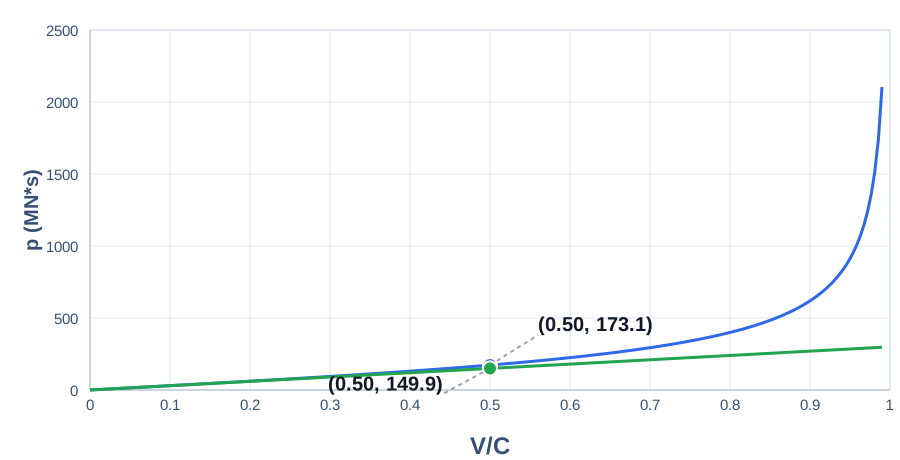
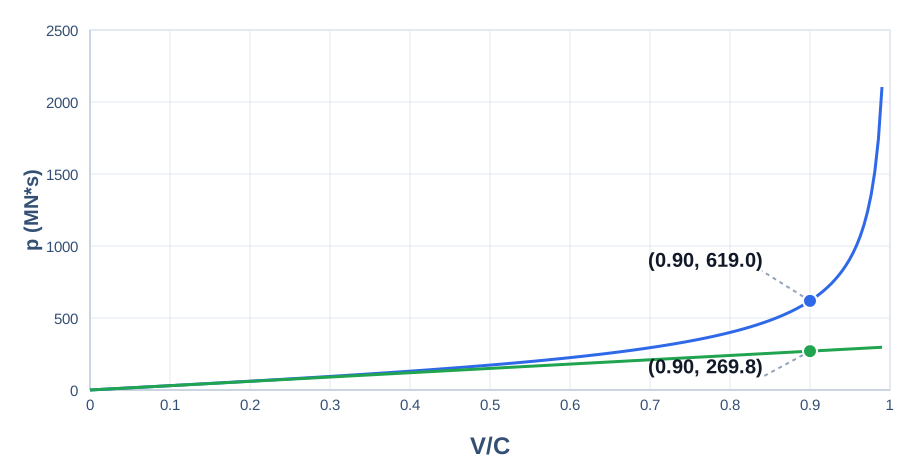
The live chart in the calculator is best for your exact input values. This static comparison adds two reference profiles so you can
quickly see how relativistic and classical momentum separate between moderate and near-light-speed regimes.
Both charts use the same model family and dual-line structure, so differences are physically meaningful and not formatting artifacts.
At $v/c=0.50$ for $m=1\,\mathrm{kg}$, relativistic momentum is about
$173.1\,\mathrm{MN\cdot s}$ while classical momentum is about
$149.9\,\mathrm{MN\cdot s}$.
This is a clean baseline for seeing the first meaningful divergence.
Profile B: 1 kg Near Light Speed
At $v/c=0.90$ for $m=1\,\mathrm{kg}$, relativistic momentum rises to about
$619.0\,\mathrm{MN\cdot s}$ while classical momentum is about
$269.8\,\mathrm{MN\cdot s}$.
This shows why classical momentum becomes strongly misleading in high-speed ranges.
Comparison takeaway: the classical curve is linear in velocity ratio, while the relativistic curve bends upward and accelerates as
$v/c$ approaches 1. The gap between them grows rapidly near light speed.
Worked Examples (Relativistic Momentum, Step by Step)
Example 1: 1 kg at 0.5c
A baseline case for checking the full chain from speed ratio to gamma to momentum ratio.
Ratio:
$$\frac{p_{rel}}{p_{classical}}\approx7.088812$$
Interpretation: relativistic momentum is more than seven times the classical value at this speed.
How to Interpret Relativistic Momentum Results Correctly
The most important interpretation rule is that relativistic momentum is frame-dependent and model-dependent.
In this calculator, all outputs are produced under special relativity with inertial-frame assumptions.
The relativistic momentum value should be read together with $v/c$, $\gamma$, and the
$p_{rel}/p_{classical}$ ratio; that trio tells you not only the magnitude, but also how far classical mechanics is drifting from valid high-speed behavior.
This is especially useful for questions like “is classical momentum still safe here?” or “how large is the relativistic correction at my speed?”.
Another practical point: compact display in $\mathrm{N\cdot s}$ prefixes is for readability only.
The base quantity remains the same physical momentum value reported in $\mathrm{kg\cdot m/s}$.
Use the compact form to communicate large scales clearly, but keep SI base units visible in technical documents to avoid ambiguity in downstream calculations.
Model Scope, Assumptions, and Boundary Conditions
This tool models special relativity only. It does not include gravitational curvature, acceleration profiles, rotating frames,
or general-relativity corrections. Input validity is strict: $0 \le v < c$ and positive rest mass.
If your scenario includes strong gravity fields or non-inertial trajectories, treat this momentum output as a controlled baseline,
then extend with an appropriate GR or dynamics model.
Numerically, rounding affects presentation but not the underlying model relation:
$p_{rel}=\gamma m v$ and $\frac{p_{rel}}{p_{classical}}=\gamma$.
For reproducible audits, keep a consistent decimal policy across scenarios and compare ratio-level behavior rather than only truncated absolute values.
Validation Workflow and Common Mistakes
A reliable validation workflow is:
(1) confirm units (kg and m/s),
(2) verify $\gamma \ge 1$,
(3) verify $p_{rel} \ge p_{classical}$ for valid inputs,
and (4) confirm $p_{rel}/p_{classical} \approx \gamma$ within rounding tolerance.
This sequence catches most user-side errors faster than manual re-derivation.
Frequent mistakes include entering speed in km/h without conversion, mixing mass units, and interpreting near-light-speed behavior with classical intuition.
If you need energy-side interpretation for the same scenario, continue with
Relativistic Energy Calculator
to compare rest, total, and kinetic energy terms under the same speed regime.