This relativistic energy calculator computes rest energy, total relativistic energy, and kinetic energy from rest mass and velocity.
It is designed for high-speed scenarios where the classical energy model is no longer accurate and Lorentz-factor scaling is required.
For related frame-based tools and formulas, explore
Relativity.
Compute total, kinetic, and rest energy from rest mass and velocity.
Results
Summary
Rest mass (kg):—
Velocity (m/s):—
v/c:—
Speed as % of c:—
Lorentz factor (γ):—
Rest energy (J):—
Total energy (J):—
Kinetic energy (J):—
Relativistic energy (J) vs velocity ratio
Step-by-step
Explanation:
Computed values
Metric
Value
Your feedback matters
What This Relativistic Energy Calculator Solves
This tool solves the full special-relativity energy breakdown for a moving particle or object: rest energy $E_0$,
total energy $E$, and relativistic kinetic energy $K$.
Given rest mass $m$ and speed $v$, the calculator applies the Lorentz factor to avoid low-speed shortcuts
and returns values in joules with readable scaled units (kJ to YJ) for large magnitudes.
Common use cases include estimating relativistic kinetic energy at high speed, comparing rest energy and total energy, and checking gamma-based energy growth. Outputs are designed to be numerically clear and physically interpretable, not just algebraically correct.
Formulas, Variables, and Interpretation
The model uses
$\gamma = \frac{1}{\sqrt{1-(v/c)^2}}$,
$E_0 = mc^2$,
$E = \gamma E_0$, and
$K = E - E_0$.
Here, $c$ is the speed of light in vacuum, $E_0$ is rest energy,
$E$ is total relativistic energy, and $K$ is kinetic energy after relativistic correction.
Two interpretation rules matter most in practice.
First, $E_0$ is nonzero whenever mass is nonzero, even at rest.
Second, as $v/c$ approaches 1, $\gamma$ rises nonlinearly,
so total and kinetic energy growth accelerate much faster than in classical mechanics.
This is why near-light-speed scenarios require relativistic energy equations instead of Newtonian approximations.
How To Read Joules and Scaled Units
The calculator always reports Joules as the primary value to preserve exact formula consistency.
When values are very large, a scaled notation is also shown in parentheses (for example PJ or EJ) to make magnitude easier to interpret.
This is a readability layer, not a different physical result.
If you are comparing scenarios, keep your decision baseline in Joules and use scaled units for reporting clarity.
A quick interpretation pattern is:
$E_0$ tells intrinsic mass-energy scale, $E$ shows total relativistic energy state,
and $K$ isolates the motion-dependent contribution.
For quality checks, verify identity consistency:
$K = E - E_0$ within rounding tolerance.
Comparative Relativistic-Energy Profiles
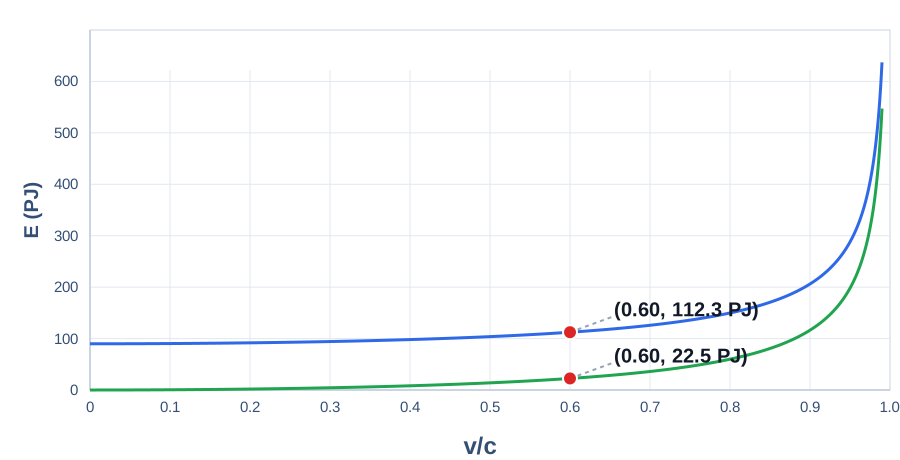
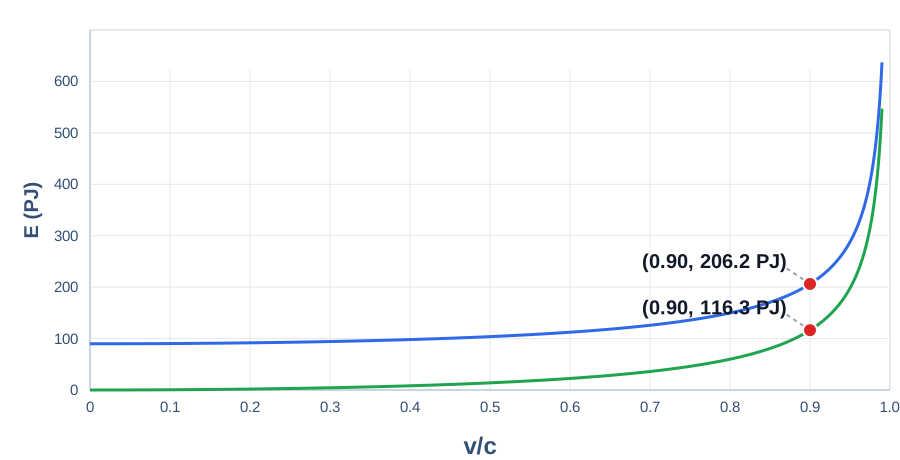
The live chart in the calculator is best for your exact inputs. This static comparison adds two benchmark profiles so users can
quickly see how both total relativistic energy and kinetic energy scale across moderate and near-light-speed ranges.
Both charts keep the same model family and dual-line structure, so differences are physically interpretable rather than visual artifacts.
Visual key:
Total energy,
Kinetic energy.
Profile A: 1 kg in a Moderate Relativistic Regime
At $v/c=0.60$ for $m=1\,\mathrm{kg}$, total energy is about $112.3\,\mathrm{PJ}$
and kinetic energy is about $22.4\,\mathrm{PJ}$. This is a strong baseline for understanding
“relativistic energy vs kinetic energy” without extreme near-$c$ amplification.
Profile B: 1 kg Near Light Speed
At $v/c=0.90$ for $m=1\,\mathrm{kg}$, total energy rises to about $206.2\,\mathrm{PJ}$
and kinetic energy to about $116.3\,\mathrm{PJ}$. This shows why high-speed energy planning must include
relativistic corrections rather than classical intuition.
Comparison takeaway: total and kinetic curves are both nonlinear, and the gap between moderate and near-light-speed states expands rapidly.
Even small ratio changes in the upper-speed region can create very large absolute energy deltas.
Worked Examples (Step by Step)
Example 1: 1 kg at 0.5c
Use this baseline case to verify every formula stage from gamma to kinetic energy.
Kinetic energy:
$$K = E - E_0 \approx 13{,}904{,}178{,}758{,}545{,}456\,\mathrm{J}\; (13.904179\,\mathrm{PJ})$$
Classical comparison:
$$K_{classical}=\frac{1}{2}mv^2=\frac{1}{2}(1)(149{,}896{,}229)^2\approx 11{,}234{,}439{,}734{,}210{,}220\,\mathrm{J}$$
Interpretation: relativistic kinetic energy is already higher than classical at 0.5c.
Example 2: 0.1 kg at 0.9c
This case demonstrates strong nonlinear growth in relativistic kinetic energy near light speed.
Kinetic energy:
$$K = E - E_0 \approx 59{,}917{,}011{,}915{,}787{,}850{,}000\,\mathrm{J}\; (59.917012\,\mathrm{EJ})$$
Classical comparison:
$$K_{classical}=\frac{1}{2}mv^2=\frac{1}{2}(1000)(239{,}833{,}966.4)^2\approx 28{,}760{,}164{,}079{,}999{,}986{,}000\,\mathrm{J}\; (28.760164\,\mathrm{EJ})$$
Interpretation: for large mass systems, relativistic correction changes planning-scale energy budgets by exajoules.
Model Scope, Limits, and Validation Workflow
This calculator applies special relativity for inertial-frame scenarios with valid speed range $0 \le v < c$
and strictly positive rest mass.
It does not include gravitational curvature effects, acceleration-phase modeling,
or radiative loss mechanisms.
Treat the result as a model-consistent relativistic estimate under these assumptions.
For robust validation, use a three-step check:
(1) confirm unit consistency for mass and velocity,
(2) verify monotonic behavior of $\gamma$, $E$, and $K$ with increasing $v/c$, and
(3) back-check identity consistency with $K = E - E_0$.
If any check fails, review units, frame assumptions, and input scale before trusting the result.
Common Mistakes in Relativistic Energy Calculations
The most common mistakes are mixing units, treating $E_0$ as optional, and applying low-speed intuition near relativistic ranges.
Another frequent error is comparing values with different mass baselines and then attributing the difference to velocity alone.
Keep mass fixed for speed-sensitivity analysis, or speed fixed for mass-scaling analysis, but avoid blending both in one quick conclusion.
Also avoid interpreting formatted scaled output (PJ, EJ) as a separate physical quantity.
It is the same Joule value written in a larger unit family for readability.
For reproducible analysis and API workflows, always keep Joule values as the canonical calculation layer.
Academic Context and References
Relativistic energy is grounded in Lorentz symmetry and mass-energy equivalence.
For foundational derivation context, Einstein's 1905 work remains historically central.
For constants and metrology-grade reference values, NIST/CODATA resources are preferred.
For modern particle-physics conventions and notation, the Particle Data Group is a high-trust source.
If your next problem focuses on high-speed momentum state rather than energy partition,
continue with the Relativistic Momentum Calculator.
If your scenario focuses on clock-rate divergence across frames,
use the Time Dilation Calculator.
Separating momentum, timing, and energy interpretations first usually prevents frame-mixing mistakes,
then you can combine outputs for a complete relativistic system analysis.
Continue with
Relativity,
expand to
Physics Calculators,
or browse all
Calculators.