Time Dilation Calculator

This time dilation calculator helps you compute relativistic clock drift from proper time and velocity in special relativity. It solves the Lorentz factor step by step, compares proper time vs observed (dilated) time, and reports the time difference in seconds and calendar form when the interval is large enough to be interpreted as years, days, hours, minutes, and seconds. For related near-light-speed motion tools and relativistic kinematics, explore Relativity.

Compute dilated time from proper time and velocity.


Results

Summary

  • Proper time (s):
  • Velocity (m/s):
  • v/c:
  • Speed as % of c:
  • Lorentz factor (gamma):
  • Time dilation increase (%):
  • Dilated time (s):
  • Time difference (s):

Time dilation increase (%) vs velocity ratio

Step-by-step

Explanation:

Computed values
Metric Value

What This Time Dilation Calculator Solves

This calculator models special relativity time dilation for inertial frames. With proper time $t_0$ and velocity $v$, it computes the Lorentz factor $\gamma$, dilated time $t$, and elapsed-time difference $\Delta t$. In practical terms, it tells you how one clock measured in its own rest frame compares with a clock observed from another frame when relative speed is a meaningful fraction of the speed of light. This is the core use case behind search intents such as "proper time vs dilated time", "Lorentz factor calculator", "time dilation step by step", and "how much time passes at 0.9c".

The tool is suitable for educational physics, conceptual checks in relativity coursework, and quick numerical validation when writing explanations for high-speed travel thought experiments. It is also useful for long-horizon comparisons where the same rate difference, when integrated over years, produces large calendar-scale divergence between clocks.

Formula, Variables, and Physical Meaning

The special relativity time-dilation model used here is: $\gamma=\frac{1}{\sqrt{1-(v/c)^2}}$, $t=\gamma t_0$, and $\Delta t=t-t_0$. The ratio $v/c$ is dimensionless and must satisfy $0 \le v < c$. Here, $t_0$ is proper time (the interval measured by a clock moving with the event sequence), and $t$ is the corresponding interval observed from the other frame.

Physically, $\gamma$ is the scaling factor that stretches observed elapsed time as relative speed increases. At small $v/c$, $\gamma$ is near 1 and the effect is tiny. As $v/c$ approaches 1, the denominator shrinks and $\gamma$ rises rapidly, making time dilation highly nonlinear. This is why high-speed examples can produce dramatic clock differences while low-speed orbital examples produce microsecond-scale drift.

How to Read the Output Correctly

The summary and computed table report values in seconds for strict numeric reproducibility. When a duration reaches at least one minute, the same result is also shown in calendar form for readability using fixed units (1 year = 365 days). This dual display is intentional: seconds preserve exact arithmetic for physics checks, while calendar form supports fast interpretation in long-duration scenarios such as mission planning thought experiments and classroom relativity narratives.

You should interpret $\Delta t$ as a difference between two frame-dependent elapsed intervals under the model assumptions, not as a contradiction. Both times are valid measurements attached to different observational contexts. This directly addresses frequent user intent queries like "which clock is correct in time dilation?" and "why does one observer see more time pass?".

Model Scope, Assumptions, and Limits

This is a special-relativity calculator for inertial-frame time dilation. It does not model gravitational time dilation, acceleration phases, turnaround asymmetry, curved spacetime geodesics, or signal propagation effects. Inputs are interpreted in SI units: proper time in seconds and velocity in meters per second. If your scenario depends on gravity fields, orbital potentials, or non-inertial trajectories, this result should be treated as a baseline approximation rather than a full general-relativity solution.

The validity window is strict: $0 \le v < c$. Any value at or above light speed is outside the domain of the formula. Numerical rounding is controlled by precision settings and does not change the underlying physical model. For best reproducibility, keep the same decimal policy across comparisons.
Comparative Time-Dilation Profiles

The live chart in the calculator is best for your exact input pair. This static comparison section adds two benchmark profiles so users can immediately see how nonlinearity changes between moderate relativistic motion and near-light-speed motion. Both charts use the same scale and equation family, so shape differences are physically meaningful and not formatting artifacts.

Profile A: Moderate Relativistic Regime

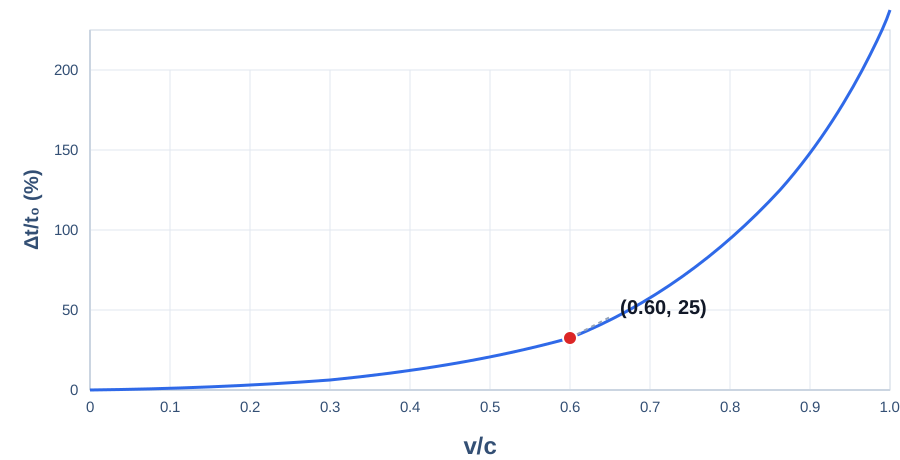
At $v/c=0.60$, dilation increase is about $25\%$. This is a strong conceptual checkpoint for "how to calculate time dilation step by step" because the curve is clearly nonlinear but still easy to reason about analytically.

Static profile of time dilation increase versus velocity ratio with a marker at v over c 0.60 and 25 percent increase.

Profile B: Near-Light-Speed Regime

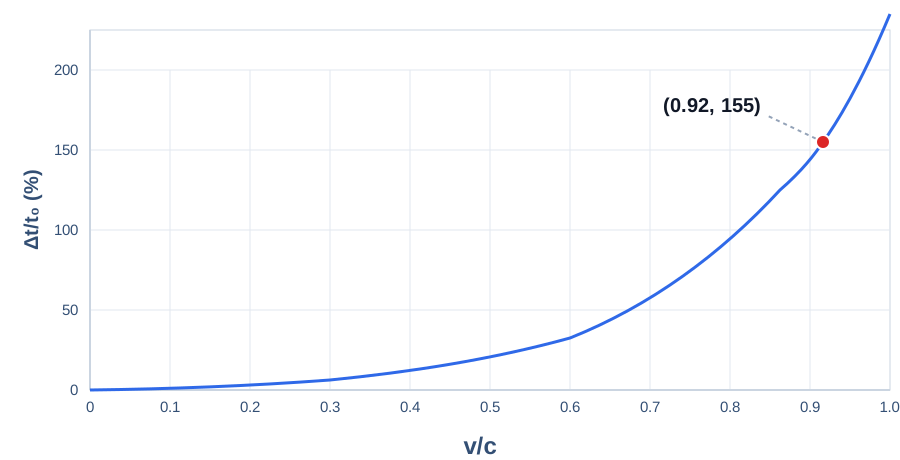
At $v/c=0.92$, dilation increase rises to about $155\%$. This illustrates why searches like "proper time vs observed time at high velocity" and "Lorentz factor growth near c" require careful interpretation: small ratio changes can create large timing divergence.

Static profile of time dilation increase versus velocity ratio with a marker at v over c 0.92 and 155 percent increase.

Comparison takeaway: the transition from sub-relativistic to strongly relativistic behavior is not linear. In practical use, this means clock-drift estimates that look small at lower fractions of $c$ can expand rapidly as mission speed rises, even before reaching the extreme edge of the domain.

Worked Examples (Relativistic Time Dilation)

Example 1: Baseline Check at 0.5c

Use this as a calibration case when validating the workflow from ratio to gamma to final elapsed times.

Given: $$t_0=1\ \mathrm{s},\quad \frac{v}{c}=0.5$$ $$\gamma=\frac{1}{\sqrt{1-\left(\frac{v}{c}\right)^2}}=\frac{1}{\sqrt{1-0.5^2}}=\frac{1}{\sqrt{0.75}}\approx1.154701$$

$$t=\gamma t_0=1.154701\times1=1.154701\ \mathrm{s}$$ $$\Delta t=t-t_0=1.154701-1=0.154701\ \mathrm{s}$$ Check: $$\frac{t}{t_0}=\frac{1.154701}{1}=1.154701=\gamma$$

Interpretation: even at half light speed, observed elapsed time is measurably larger than proper time.

Example 2: One Day at GPS-Like Orbital Speed

This scenario highlights tiny per-second relativistic effects that still matter in precision timing systems over long operation windows.

Given: $$t_0=86{,}400\ \mathrm{s},\quad v=3{,}874\ \mathrm{m/s}$$ $$\frac{v}{c}=\frac{3{,}874}{299{,}792{,}458}\approx1.292\times10^{-5}$$ $$\gamma=\frac{1}{\sqrt{1-\left(1.292\times10^{-5}\right)^2}}\approx1.0000000000835$$

$$t=\gamma t_0\approx1.0000000000835\times86{,}400=86{,}400.000007\ \mathrm{s}$$ $$\Delta t=t-t_0=86{,}400.000007-86{,}400=0.000007\ \mathrm{s}$$ Calendar-form: $$t\approx86{,}400.000007\ \mathrm{s}\ (\text{1 d, 0.000007 s})$$

Interpretation: the effect is extremely small in one day, but cumulative drift is operationally important in high-accuracy clock systems.

Example 3: High-Speed Trip Clock at 0.9c

This is a classic near-light-speed benchmark where nonlinear relativistic effects are obvious in short time intervals.

Given: $$t_0=10\ \mathrm{s},\quad \frac{v}{c}=0.9$$ $$\gamma=\frac{1}{\sqrt{1-\left(\frac{v}{c}\right)^2}}=\frac{1}{\sqrt{1-0.9^2}}=\frac{1}{\sqrt{0.19}}\approx2.294157$$

$$t=\gamma t_0=2.294157\times10=22.941573\ \mathrm{s}$$ $$\Delta t=t-t_0=22.941573-10=12.941573\ \mathrm{s}$$ Check: $$\frac{t}{t_0}=\frac{22.941573}{10}\approx2.294157=\gamma$$

Interpretation: as velocity approaches light speed, the difference between observed and proper time grows quickly.

Example 4: Long-Horizon Relativistic Drift (15 y at 0.8c)

This long-duration case is useful for human-readable interpretation where results are naturally understood in years.

Given: $$t_0=473{,}040{,}000\ \mathrm{s}\ (\text{15 y}),\quad \frac{v}{c}=0.8$$ $$\gamma=\frac{1}{\sqrt{1-\left(\frac{v}{c}\right)^2}}=\frac{1}{\sqrt{1-0.8^2}}=\frac{1}{0.6}=1.666667$$

$$t=\gamma t_0=1.666667\times473{,}040{,}000\approx788{,}400{,}000\ \mathrm{s}$$ $$\Delta t=t-t_0=788{,}400{,}000-473{,}040{,}000=315{,}360{,}000\ \mathrm{s}$$ Calendar-form: $$t\approx788{,}400{,}000\ \mathrm{s}\ (\text{25 y}),\quad \Delta t\approx315{,}360{,}000\ \mathrm{s}\ (\text{10 y})$$

Interpretation: over long horizons, moderate relativistic factors can become multi-year divergences.

Academic Context and Reference Notes

The tool follows the standard special-relativity time-dilation relation from inertial-frame kinematics. For primary historical context, see Einstein's 1905 paper on electrodynamics of moving bodies. For modern precision constants and metrology, consult NIST/CODATA references for the speed of light and unit conventions. For an applied systems perspective, GPS timing literature provides practical demonstrations of relativistic time effects in real engineering systems.

Suggested references: Einstein (1905), Special Relativity, NIST Fundamental Physical Constants, Ashby (2003), Relativity in the Global Positioning System. Use these as conceptual anchors for interpretation, assumptions, and unit rigor.

Common Mistakes and Validation Checklist

Frequent errors include mixing units, entering speed as a percentage where m/s is required, assuming the formula is valid at or above light speed, or reading calendar-form output as a replacement for exact seconds. A robust validation sequence is: confirm units, check that $0 \le v < c$, verify $\gamma \ge 1$, and ensure $t \ge t_0$ for valid positive intervals.

If your use case includes gravity wells, acceleration segments, or path-dependent trajectory phases, pair this tool with the broader relativistic context pages and treat this result as the special-relativity component only.

Continue with related tools in Relativity, broaden your context in Physics Calculators, or browse all Calculators.


Questions About the Time Dilation Calculator

Quick answers on proper time, gamma, speed ratio, assumptions, and interpretation.